AgentEX – synthesis of results
The AgentEx project seeked to explain why, how, and when users use resources sustainably, particularly as climate change often increases ecological uncertainty. It focused on how resource state changes are perceived, how (un)expected changes are attributed (to oneself, others, or external factors), and how these perceptions shape individual and collective behaviour.
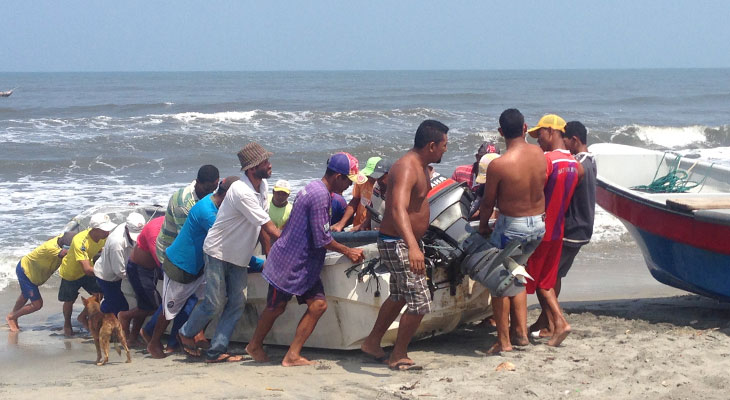
Photo: Juan Rocha
The overall research question that the project aimed to address was: What is the effect of perceived (un)expected resource state change on individual decisions and collective resource use? In particular, we wanted to find answers to the following: How is resource change perceived and attributed? Is attribution influenced by individual, group, or situational factors? How does attribution shape behaviour?
Methods
The project employed a mixed-methods approach, combining agent-based modelling (ABM) and behavioural experiments. Data from field experiments in Thailand and Colombia, involving a dynamic common pool resource game, provided empirical insights into behavioural responses under uncertainty. These were complemented by questionnaires, interviews and systematic observations. Combined they informed an empirically grounded explanation of sustainable resource use, alongside alternative explanations based on causal attribution literature. ABM formalise, test, and explored these explanations, shedding light on the interplay between collective action and resource sustainability in a changing climate.
Findings
The main finding is that the way the (un)expected resource state differs, individual characteristics, group dynamics and wider (cultural) context come together. Findings from our empirical studies — with fishers in Thailand and Colombia — to understand how the perception of ecological uncertainty affects cooperation and resource use — indicate that unexpected ecological changes often lead to a sense of shared responsibility and are typically attributed to others or the collective group, particularly when less resource is available than expected. Conversely, expected changes tend to reinforce existing behaviours and trust.
Observations suggest that group dynamics and community norms significantly influence how resource users respond to both overused and not overused resources. Methodologically, the project advanced the understanding of human–ecological system interactions and sustainable resource management. The suspension of empirical work due to the pandemic provided an opportunity to refine methodological approaches. The research demonstrates the value of integrating agent-based modelling (ABM) with behavioural experiments for empirically embedded theory development, distinguishing its role in (1) the exploratory, evidence-based generation of explanations and (2) the testing of behavioural explanations in complex environments (Wijermans et al., 2022).
More broadly, the work in this project through synthesising and making role of ABMs for theory development more actionably reflect human behaviour realistically. This was done conceptually (Wijermans et al., 2023a; Antosz et al., 2023; Berger et al., 2023; Constantino et al., 2021) and applied to different domains, e.g. crowd dynamics (Wijermans & Templeton, 2022), disaster preparedness (Giardini et al., 2023) and theories, e.g. social identity approaches (Wijermans et al., (2023b), Scholz et al., (2023)).
Project team:
Ferdinanda Wijermans (PI) and Maja Schlüter from Stockholm Resilience Centre, Stockholm University, Therese Lindahl and Caroline Schill from Beijer Institute of Ecological Economics.
Funding:
Swedish Research Council for Sustainable Development (Formas) (# 2018-00401)
Research outputs:
Berger, U., A. Bell, C. M. Barton, E. Chappin, G. Dreßler, T. Filatova, T. Fronville, A. Lee, E. van Loon, I. Lorscheid, M. Meyer, B. Müller, C. Piou, V. Radchuk, N. Roxburgh, L. Schüler, C. Troost, N. Wijermans, T. G. Williams, … V. Grimm. 2024. Towards reusable building blocks for agent-based modelling and theory development. Environmental Modelling & Software 175:106003. https://doi.org/10.1016/j.envsoft.2024.106003
Giardini, F., M. Borit, H. Verhagen, N. Wijermans. 2024. Modeling realistic human behavior in disasters: a rapid literature review of agent-based models reviews. In: C. Elsenbroich, H. Verhagen, editors. Advances in Social Simulation (ESSA 2023). Springer Proceedings in Complexity. Cham, Switzerland: Springer. https://doi.org/10.1007/978-3-031-57785-7_13
Wijermans, N., G. Scholz, É. Chappin, A. Heppenstall, T. Filatova, J. G. Polhill, C. Semeniuk, F. Stöppler. 2023. Agent decision-making: the elephant in the room—enabling the justification of decision model fit in social-ecological models. Environmental Modelling & Software:105850. https://doi.org/10.1016/j.envsoft.2023.105850
Antosz, P., D. Birks, B. Edmonds, A. Heppenstall, R. Meyer, J. G. Polhill, D. O’Sullivan, N. Wijermans. 2023. What do you want theory for? A pragmatic analysis of the roles of “theory” in agent-based modelling. Environmental Modelling & Software 168:105802. https://doi.org/10.1016/j.envsoft.2023.105802
Wijermans, N., G. Scholz, M. Neumann, R. Paolillo, A. Templeton. 2023. Editorial: social identity modelling. Journal of Artificial Societies and Social Simulation 26(3). https://doi.org/10.18564/jasss.5188
Scholz, G., N. Wijermans, R. Paolillo, M. Neumann, T. Masson, É. Chappin, A. Templeton, G. Kocheril. 2023. Social agents? A systematic review of social identity formalizations. Journal of Artificial Societies and Social Simulation 26(2). https://doi.org/10.18564/jasss.5066
Wijermans, N., C. Schill, T. Lindahl, M. Schlüter. 2022. Combining approaches: looking behind the scenes of integrating multiple types of evidence from controlled behavioural experiments through agent-based modelling. International Journal of Social Research Methodology:1–13. https://doi.org/10.1080/13645579.2022.2050120
Constantino, S. M., M. Schlüter, E. U. Weber, N. Wijermans. 2021. Cognition and behavior in context: a framework and theories to explain natural resource use decisions in social-ecological systems. Sustainability Science 16(5):1651–1671. https://doi.org/10.1007/s11625-021-00989-w
NEWS